 This is the arrangement of the installation I have gone for. Throughout the duration of the exhibition the sculptures will slowly dissolve using water from the tank, making use of construction and deconstruction as a narrative to portray the problems faced by plankton and the struggle to calcify and build shells.
Monday, 29 August 2011
MA Show
This is the arrangement of the installation I have gone for. Throughout the duration of the exhibition the sculptures will slowly dissolve using water from the tank, making use of construction and deconstruction as a narrative to portray the problems faced by plankton and the struggle to calcify and build shells.


Cape Farewell
I recently had the opportunity to go on three expeditions with Cape Farewell around Cornwall and the Isles of Scilly, working alongside other artists and scientists. Stage one was at the Eden Project where we were able to sleep over in the rain forest bi ome, then go out into St Austle. The second leg was on the lizard and the third was in the Isles of Scilly concentrating our time on Tresco and St Agnes.
It was a truly amazing experience and one I will share as soon as I have handed in for my MA with a full report. We are also planning a group exhibition at the start of October I will put up more details when they become available.
It was a truly amazing experience and one I will share as soon as I have handed in for my MA with a full report. We are also planning a group exhibition at the start of October I will put up more details when they become available.
Tuesday, 25 January 2011


Thursday, 2 December 2010
Art As Inquiry
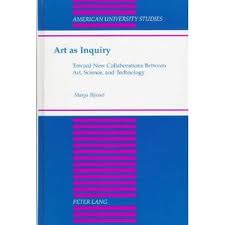
Art as Inquiry : toward new collaborations between art, science, and technology Marga Bijvoet. 1997 New York : Peter Lang, ISBN:0820433829
Art as Inquiry is an investigation undertaken by Marga Bijvoet, into how artists have taken a transdisciplinary approach to their practice. The book starts with a historical introduction as to how this new way of working (at the time) came into existence with the foundation of groups such as The Research Laboratory of Electronics at MIT with its beginnings routed in visual communications.
As far as relation to my own practice this introduction plus chapters four and eight are of most relevance. Chapter four entitled Hans Haake Systems Artist takes a fairly fleeting look at Hans Haake’s career, and as the title suggests, his ecological systems approach to his work. Chapter eight, The Artist as ecologist, concentrates on Alan Sonfist using Crystal Globe and Crystal Enclosure as examples, and the Harrisons, who I find particularly interesting. For the Harrisons Bijvoet runs through two main bodies of work the Survival series, enclosed man made systems and Lagoon cycles much larger scale pieces. Interestingly it turns out that many of the Harrisons early pieces did more environmental damage than good, both of whom are now lectures in the subject.
This text is very informative but its use seems to be more of a historical significance than that for researching contemporary artists. For references of the beginnings of the integration of practices this book holds the most information I have been able to find in a single book. It is however a little dated, as the mixing of art science and technology has advanced quite significantly since this title was written, with practitioners such as Brandon Ballengee lending science as much as science lends his art, something that seems to be more of a one way science to art discussion in this book.
Biogenous Interpretation
These are some examples of models i am currently producing. Through making I have also discovered an echo in the struggle to physically produce the objects and that of the real things. In the process I found that the sculptures would often collapse and break, which i feel gives a poetic resemblance to the struggle of the organisms producing their own shells. An important moment which can only be captured through practice based research and first hand experience, intrinsic and vital information. 


Biogenous Sediment

After my last exhibition I have spent the last few weeks developing my ideas around ocean acidification. I came to the decision that at this stage of my research corals were too high up the marine scale, and I wanted to start at the beginning of the chain.
I had read in the weather makers about the Ocean drilling programme and a very significant project that took place at Shatsky Rise, where core samples were taken revealing deposits at a certain depth that up until this time had been missing from other records. These findings revealed a distinct lack of foraminifera, micro organisms used to construct an image of ocean conditions in the past. This meant that the oceans at this time were highly acidic and these creatures couldn't calcify to produce there shells, a trend that we are currently seeing. Being highly important on the food chain, it is believed the lack of foraminifera plus poor ocean conditions would have caused a mass ocean extinction.
Foraminifera along with other biogenous sediments and shell building plankton's trap carbon when they build shells. The increase in atmospheric carbon is causing more acidic oceans resulting in their shells dissolving and the inability to calcify at full capacity. When these organisms die they sink to the sea floor trapping vast amounts of carbon (50,000,000gt), only now, due to increased acidity these dead organisms are dissolving releasing the carbon back into the ocean, thus increasing acidity, and so a spiralling cycle has begun, which I believe to be very bad news indeed for the state of the worlds oceans.
Monday, 25 October 2010
Chalk

Ignored and trampled by some, care and interest paid by others "Chalk" seems to follow the same Course as the Great Barrier Reef. Those who wish to take part and notice what is happening to this marine ecology interact, remove a piece of sea shell chalk and help it on its way back to the ocean to help nullify the effects of ocean acidification. To others this catastrophic effect of climate change simply continues to pass them by.

"Chalk" is made up of three main parts. On the wall is a backlit map of Australia. Removed from this is a satalight perspective of the Great Barrier Reef, which is then mirrored and painted onto the floor. Across this are hundreds of sea shell chalk balls where participants are asked to remove them and transport them back to the ocean in brown recycled paper bags, on which details are printed, providing instructions and acting as a business card at the same time.

The final part us a collection of plaster cast corals housed in acidified sea water slowly dissolving over time, resulting in a sediment filled jar.
Tuesday, 3 August 2010
Sea Sick the Hidden Ecological Crisis of the Global Ocean, Alanna Mitchell, 2008, One World, ISBN 978-1-85168-678-0

Sea sick follows journalist Alanna Mitchell across the globe on a voyage of discovery. Working with scientists she finds out just how sick our oceans are, and just how vital they are to the survival of not just humans but to the entire planet as we know it. The back cover reads “you thought the climate was the problem actually, it’s the ocean” and the book shows us just why this is.
Through a series of case studies Mitchell reveals the truth about the state of our ocean, not just as a result of climate change but, habitats, changes in marine breeding behaviour, over fishing and other commercial practises, extinction of vital plankton species and issues such as migratory routes of fish and dead zones. Ultimately explaining that the state of our climate largely relies on the state and stability of our ocean, and in fact, Earth wouldn’t have an atmosphere or climate if it wasn’t for the ocean. Earth relies on plankton to provide 50% of the planets oxygen and likewise its ability to absorb carbon, without it the planet as we know it is doomed.
Not everything in the book is doom and gloom though. Mitchell makes reference to there being hope, and if we act now, her and scientists alike believe we can save our oceans and with it the planet.
This is an excellent book putting into perspective the imminent danger of total collapse, which the ocean faces. It is full of facts and figures but is by no means overwhelming. If I were to recommend a book to explain how intrinsic the good health of the sea is to our survival then this is it. An entrancing read emphasising the need for a greater and wider understanding of our ocean.
Thursday, 29 July 2010
Sea Shell Chalk
 This is a piece i have been working on the last few weeks, in which i have been producing small balls of chalk from crushing sea shells. These balls are laid out along a chalk map of the Great Barrier Reef, and the viewer is invited to take them away and return them to the ocean in bags with information on them also acting as my business card.
Buy people removing the chalk, I am trying to make a statement about the disappearance of reef systems, with only a ghostly trace of the Barrier Reef left behind. At the same time the act of putting these balls of natural calcium carbonate back into the sea, has implications of a nullifying effect on the rising PH levels of of the ocean, one of the major threats of coral reef degradation.

These jars are also an idea i have been playing about with, where plaster casts of corals are held in overly acidic sea water, the result of which is the dissolving of the casts over a period of a couple of weeks, being left with a layer of sediment.
Thursday, 22 July 2010
Natural History Museum
I recently payed a visit to the Natural History Museum London as part of my research, only to discover the newly constructed Darwin Centre, who's premises houses large numbers of marine specimens along with research facilities, catalogues, examples of plants, and land invertebrates.  The centre is also home to an interactive wall, highlighting the dangers coral reefs face due to climate change, covering ocean acidification, changes in ocean currents and the transference of carbon between land and sea. The piece is highly colourful and extremely intriguing inviting the viewer to explore the reef whilst imposing the message that these Eco systems are in trouble.

The centre is also home to an interactive wall, highlighting the dangers coral reefs face due to climate change, covering ocean acidification, changes in ocean currents and the transference of carbon between land and sea. The piece is highly colourful and extremely intriguing inviting the viewer to explore the reef whilst imposing the message that these Eco systems are in trouble.Monday, 12 April 2010


Tuesday, 9 March 2010
Japanese Knotweed. www.news.bbc.co.uk
A tiny Japanese insect that could help the fight against an aggressive superweed has been given the go-ahead for a trial release in England.
Since Japanese knotweed was introduced to the UK it has rapidly spread, and the plant currently costs over £150m a year to control and clear.
But scientists say a natural predator in the weed's native home of Japan could also help to control it here.
The insect will initially be released in a handful of sites this spring.
This is the first time that biocontrol - the use of a "natural predator" to control a pest - has been used in the EU to fight a weed.
Wildlife Minister Huw Irranca-Davies said: "These tiny insects, which naturally prey on Japanese Knotweed, will help free local authorities and industry from the huge cost of treating and killing this devastating plant."
Alien invaders
Japanese knotweed was introduced to the UK by the Victorians as an ornamental plant, but it soon escaped from gardens and began its rampant spread throughout the UK.
It grows incredibly quickly - more than one metre a month - and rapidly swamps any other vegetation in its path.
It is so hardy that it can burst through tarmac and concrete, causing costly damage to pavements, roads and buildings.
Green Room: Hailing the arrival of alien predators
But removal is difficult and expensive; new estimates suggest it costs the UK economy £150m a year.
However, in Japan, the plant is common but does not rage out of control like it does in the UK, thanks to the natural predators that keep it in check.
Scientists at Cabi - a not-for-profit agricultural research organisation - used this as their starting point to track down a potential knotweed solution.
They looked at the superweed's natural predators - nearly 200 species of plant-eating insects and about 40 species of fungi - with the aim of finding one with an appetite for Japanese knotweed and little else.
After testing their candidates on 90 different UK plant species, including plants closely related to Japanese knotweed such as bindweeds and important crops and ornamental species, they discovered a psyllid called Aphalara itadori was the best control agent.
The little insect feeds on the sap of the superweed, stunting its growth.
Dr Dick Shaw, the lead researcher on the project from Cabi, told BBC News: "Safety is our top priority. We are lucky that we do have an extremely specific agent - it just eats invasive knotweeds."
This timelapse footage shows Japanese knotweed growing more than 1m-tall (3ft) in just three weeks
Following peer review by the Advisory Committee on Releases to the Environment and a public consultation, the UK government has now given the go-ahead for release of Aphalara itadori, under licence, in England.
The Welsh Assembly is expected to announce its decision on the psyllid soon.
The insects will initially be released on a handful of sites.
These will be isolated and, in addition to as having the superweed present, will also have UK species that are closely related to Japanese knotweed planted there to check that the psyllid only targets the invasive species.
Dr Shaw said: "In the early stages, a contingency plan is in place so that should, in the unlikely event, any unintended consequences be detected, we will be able to do something about it.
"Insecticide and herbicide treatment will be on standby for rapid response."
If this phase is successful, the insect will be released at further sites, where it will undergo an intensive monitoring programme over the next five years.
Dr Shaw said: "On the localised sites, I would expect to see damaged knotweed this season.
"However, biocontrol is a long-term strategy - it could take five to 10 years to have a real impact."
The government believes that if the plan is successful it will reduce the costs to the building and engineering industries of clearing the plant.
However, some critics say that it is impossible to be certain that the Japanese insect will only target the superweed and could attack other species once in the wild.
--------------------------------------------------------------------------------
Is there Japanese Knotweed growing in your area? Has it caused damage? Should we use insects to control it? Send us your comments and your pictures of Japanese knotweed.
Since Japanese knotweed was introduced to the UK it has rapidly spread, and the plant currently costs over £150m a year to control and clear.
But scientists say a natural predator in the weed's native home of Japan could also help to control it here.
The insect will initially be released in a handful of sites this spring.
This is the first time that biocontrol - the use of a "natural predator" to control a pest - has been used in the EU to fight a weed.
Wildlife Minister Huw Irranca-Davies said: "These tiny insects, which naturally prey on Japanese Knotweed, will help free local authorities and industry from the huge cost of treating and killing this devastating plant."
Alien invaders
Japanese knotweed was introduced to the UK by the Victorians as an ornamental plant, but it soon escaped from gardens and began its rampant spread throughout the UK.
It grows incredibly quickly - more than one metre a month - and rapidly swamps any other vegetation in its path.
It is so hardy that it can burst through tarmac and concrete, causing costly damage to pavements, roads and buildings.
Green Room: Hailing the arrival of alien predators
But removal is difficult and expensive; new estimates suggest it costs the UK economy £150m a year.
However, in Japan, the plant is common but does not rage out of control like it does in the UK, thanks to the natural predators that keep it in check.
Scientists at Cabi - a not-for-profit agricultural research organisation - used this as their starting point to track down a potential knotweed solution.
They looked at the superweed's natural predators - nearly 200 species of plant-eating insects and about 40 species of fungi - with the aim of finding one with an appetite for Japanese knotweed and little else.
After testing their candidates on 90 different UK plant species, including plants closely related to Japanese knotweed such as bindweeds and important crops and ornamental species, they discovered a psyllid called Aphalara itadori was the best control agent.
The little insect feeds on the sap of the superweed, stunting its growth.
Dr Dick Shaw, the lead researcher on the project from Cabi, told BBC News: "Safety is our top priority. We are lucky that we do have an extremely specific agent - it just eats invasive knotweeds."
This timelapse footage shows Japanese knotweed growing more than 1m-tall (3ft) in just three weeks
Following peer review by the Advisory Committee on Releases to the Environment and a public consultation, the UK government has now given the go-ahead for release of Aphalara itadori, under licence, in England.
The Welsh Assembly is expected to announce its decision on the psyllid soon.
The insects will initially be released on a handful of sites.
These will be isolated and, in addition to as having the superweed present, will also have UK species that are closely related to Japanese knotweed planted there to check that the psyllid only targets the invasive species.
Dr Shaw said: "In the early stages, a contingency plan is in place so that should, in the unlikely event, any unintended consequences be detected, we will be able to do something about it.
"Insecticide and herbicide treatment will be on standby for rapid response."
If this phase is successful, the insect will be released at further sites, where it will undergo an intensive monitoring programme over the next five years.
Dr Shaw said: "On the localised sites, I would expect to see damaged knotweed this season.
"However, biocontrol is a long-term strategy - it could take five to 10 years to have a real impact."
The government believes that if the plan is successful it will reduce the costs to the building and engineering industries of clearing the plant.
However, some critics say that it is impossible to be certain that the Japanese insect will only target the superweed and could attack other species once in the wild.
--------------------------------------------------------------------------------
Is there Japanese Knotweed growing in your area? Has it caused damage? Should we use insects to control it? Send us your comments and your pictures of Japanese knotweed.
Monday, 1 March 2010
Aquarium Corals, Eric H. Borneman 2001, T.F.H publications, Inc, ISBN 1-890087-47-5

Borneman is an aquarist and researcher and has written periodicals, books, and speaks frequently at aquarist and scientific conferences. Aquarium Corals is seen to be one of the definitive guides to coral husbandry amongst peers, scientists and hobbyists alike.
Although entitled “Aquarium” the book is far from just a guide to keeping corals in the home. It includes taxonomic identification (scientific and general) of pretty much every coral in known existence, with each species natural and captive requirements. It informs the reader on water chemistry around the world, history, conservation, diseases, breeding and propagation, feeding, light waves, how to set up a captive system from start to finish, and is full of detailed scientific information on coral make up from polyp structure to the microscopic level of zooxanthellae. If you need to know anything about corals I can pretty much guarantee the information you require will be in this book. To coincide with all this information are hundreds of high quality images capturing the essence of the reef and its individual inhabitants.
Aquarium Corals has been one of my main sources of information on corals and reef systems. Throughout my coral keeping period this book proved to be invaluable. As far as relating to my practice, it has provided me with the insight to just how complex and fragile our reefs are. It seems to me plainly obvious the huge effects climate change will have, this book points out that even the smallest fluctuations in aquarium stability will have fairly disastrous effects, let alone on a whole ocean. However the conservation chapter in this book is sparse, and doesn’t contain the information I would like to see on the effects of climate change on the reef. It does go into diseases, but doesn’t directly relate the two like other sources have, perhaps due to the date of publication and reluctance to acknowledge global warming in America.
Although entitled “Aquarium” the book is far from just a guide to keeping corals in the home. It includes taxonomic identification (scientific and general) of pretty much every coral in known existence, with each species natural and captive requirements. It informs the reader on water chemistry around the world, history, conservation, diseases, breeding and propagation, feeding, light waves, how to set up a captive system from start to finish, and is full of detailed scientific information on coral make up from polyp structure to the microscopic level of zooxanthellae. If you need to know anything about corals I can pretty much guarantee the information you require will be in this book. To coincide with all this information are hundreds of high quality images capturing the essence of the reef and its individual inhabitants.
Aquarium Corals has been one of my main sources of information on corals and reef systems. Throughout my coral keeping period this book proved to be invaluable. As far as relating to my practice, it has provided me with the insight to just how complex and fragile our reefs are. It seems to me plainly obvious the huge effects climate change will have, this book points out that even the smallest fluctuations in aquarium stability will have fairly disastrous effects, let alone on a whole ocean. However the conservation chapter in this book is sparse, and doesn’t contain the information I would like to see on the effects of climate change on the reef. It does go into diseases, but doesn’t directly relate the two like other sources have, perhaps due to the date of publication and reluctance to acknowledge global warming in America.
Artful Ecologies, Art Nature and Environment Conference 2006, RANE research cluster and University College Falmouth, Edited Daro Montag, 2008
 Susan Boafo "Speaking With The Sun"
Artful Ecologies is a publication to coincide with the RANE (research in art, nature and environment) conference Artful Ecologies held in Falmouth, Cornwall 2006 led by Daro Montag. The conference was held to look at the global crisis we face as a result of climate change, and the role of the artist within the subject. The book includes a collection of papers submitted by speakers, and accounts of work produced by artists, largely in the local environment.
Speakers included Tim Collins, Reiko Goto, John K. Grande, Stacy Levy, F. David Peat, Alan Sonfist, George Steinmann and Suzi Gablik who was unable to attend but provided a paper for the conference. Each of the speakers contributed views on art into today’s society, focusing on our environment, and delving into the subjects of spirituality, symbolism and the world of the transdiscipinary.
Artists include Stephen Turner, Jane Atkinson, Susan Boafo, Georg Dietzler, Martin Prothero, Dave Pritchard, Stacy Righton, Andy Webster, Jon Bird and Kerry Morrison. Similarly the work produced comes from the transdicsiplinarity and multidisciplinary of art, science and nature. Processes vary from data collection of geology and water properties, through to natural phenomenon and electro chemistry, each producing visual interpritations from the information gathered.
My own practice is currently residing in the transdisciplinary of art nature and science. This book is of particular interest to me, giving an insight into practises and processes used by artists working within my field. It also provides a range of areas for further research and artists to look at.
Speakers included Tim Collins, Reiko Goto, John K. Grande, Stacy Levy, F. David Peat, Alan Sonfist, George Steinmann and Suzi Gablik who was unable to attend but provided a paper for the conference. Each of the speakers contributed views on art into today’s society, focusing on our environment, and delving into the subjects of spirituality, symbolism and the world of the transdiscipinary.
Artists include Stephen Turner, Jane Atkinson, Susan Boafo, Georg Dietzler, Martin Prothero, Dave Pritchard, Stacy Righton, Andy Webster, Jon Bird and Kerry Morrison. Similarly the work produced comes from the transdicsiplinarity and multidisciplinary of art, science and nature. Processes vary from data collection of geology and water properties, through to natural phenomenon and electro chemistry, each producing visual interpritations from the information gathered.
My own practice is currently residing in the transdisciplinary of art nature and science. This book is of particular interest to me, giving an insight into practises and processes used by artists working within my field. It also provides a range of areas for further research and artists to look at.
Monday, 15 February 2010


Hyperbolic geometry
From Wikipedia, the free encyclopedia
Jump to: navigation, search
Lines through a given point P and asymptotic to line R.
A triangle immersed in a saddle-shape plane (a hyperbolic paraboloid), as well as two diverging ultraparallel lines.In mathematics, hyperbolic geometry (also called Lobachevskian geometry or Bolyai-Lobachevskian geometry) is a non-Euclidean geometry, meaning that the parallel postulate of Euclidean geometry is replaced. The parallel postulate in Euclidean geometry is equivalent to the statement that, in two dimensional space, for any given line l and point P not on l, there is exactly one line through P that does not intersect l; i.e., that is parallel to l. In hyperbolic geometry there are at least two distinct lines through P which do not intersect l, so the parallel postulate is false. Models have been constructed within Euclidean geometry that obey the axioms of hyperbolic geometry, thus proving that the parallel postulate is independent of the other postulates of Euclid.
Because there is no precise hyperbolic analogue to Euclidean parallel lines, the hyperbolic use of parallel and related terms varies among writers. In this article, the two limiting lines are called asymptotic and lines sharing a common perpendicular are called ultraparallel; the simple word parallel may apply to both.
A characteristic property of hyperbolic geometry is that the angles of a triangle add to less than a straight angle (half circle). In the limit as the vertices go to infinity, there are even ideal hyperbolic triangles in which all three angles are 0°.
Contents [hide]
1 Non-intersecting lines
2 Triangles
3 Circles, Spheres, and Balls
4 History
5 Models of the hyperbolic plane
6 Visualizing hyperbolic geometry
7 Gyrovector spaces
8 See also
9 Notes
10 References
11 External links
[edit] Non-intersecting lines
An interesting property of hyperbolic geometry follows from the occurrence of more than one parallel line through a point P: there are two classes of non-intersecting lines. Let B be the point on l such that the line PB is perpendicular to l. Consider the line x through P such that x does not intersect l, and the angle θ between PB and x counterclockwise from PB is as small as possible; i.e., any smaller angle will force the line to intersect l. This is called an asymptotic line in hyperbolic geometry. Symmetrically, the line y that forms the same angle θ between PB and itself but clockwise from PB will also be asymptotic. x and y are the only two lines asymptotic to l through P. All other lines through P not intersecting l, with angles greater than θ with PB, are called ultraparallel (or disjointly parallel) to l. Notice that since there are an infinite number of possible angles between θ and 90 degrees, and each one will determine two lines through P and disjointly parallel to l, there exist an infinite number of ultraparallel lines.
Thus we have this modified form of the parallel postulate: In hyperbolic geometry, given any line l, and point P not on l, there are exactly two lines through P which are asymptotic to l, and infinitely many lines through P ultraparallel to l.
The differences between these types of lines can also be looked at in the following way: the distance between asymptotic lines shrinks toward zero in one direction and grows without bound in the other; the distance between ultraparallel lines (eventually) increases in both directions. The ultraparallel theorem states that there is a unique line in the hyperbolic plane that is perpendicular to each of a given pair of ultraparallel lines.
In Euclidean geometry, the angle of parallelism is a constant; that is, any distance between parallel lines yields an angle of parallelism equal to 90°. In hyperbolic geometry, the angle of parallelism varies with the Π(p) function. This function, described by Nikolai Ivanovich Lobachevsky, produces a unique angle of parallelism for each distance . As the distance gets shorter, Π(p) approaches 90°, whereas with increasing distance Π(p) approaches 0°. Thus, as distances get smaller, the hyperbolic plane behaves more and more like Euclidean geometry. Indeed, on small scales compared to , where is the (constant) Gaussian curvature of the plane, an observer would have a hard time determining whether he is in the Euclidean or the hyperbolic plane.
[edit] Triangles
Distances in the hyperbolic plane can be measured in terms of a unit of length , analogous to the radius of the sphere in spherical geometry. Using this unit of length a theorem in hyperbolic geometry can be stated which is analogous to the Pythagorean theorem. If are the legs and is the hypotenuse of a right triangle all measured in this unit then:
The cosh function is a hyperbolic function which is an analog of the standard cosine function. All six of the standard trigonometric functions have hyperbolic analogs. In trigonometric relations involving the sides and angles of a hyperbolic triangle the hyperbolic functions are applied to the sides and the standard trigonometric functions are applied to the angles. For example the law of sines for hyperbolic triangles is:
For more of these trigonometric relationships see hyperbolic triangles.
Unlike Euclidean triangles whose angles always add up to 180 degrees or π radians the sum of the angles of a hyperbolic triangle is always strictly less than 180 degrees. The difference is sometimes referred to as the defect. The area of a hyperbolic triangle is given by its defect multiplied by R2 where . As a consequence all hyperbolic triangles have an area which is less than πR2. The area of an ideal hyperbolic triangle is equal to this maximum.
As in spherical geometry the only similar triangles are congruent triangles.
[edit] Circles, Spheres, and Balls
In hyperbolic geometry the circumference of a circle is greater than times the diameter. It is in fact equal to
where is the radius of the circle. Its area is
The volume of a sphere is
where again is the radius and its surface area is
.
For the the surface of a sphere in n dimensional space the corresponding expression is
where is full the n dimensional solid angle:
.
The denominator uses the gamma function.
The volume of the ball in n dimensional space is:
.
[edit] History
A number of geometers made attempts to prove the parallel postulate by assuming its negation and trying to derive a contradiction, including Proclus, Ibn al-Haytham (Alhacen), Omar Khayyám,[1] Nasir al-Din al-Tusi, Witelo, Gersonides, Alfonso, and later Giovanni Gerolamo Saccheri, John Wallis, Johann Heinrich Lambert, and Legendre.[2] Their attempts failed, but their efforts gave birth to hyperbolic geometry.
The theorems of Alhacen, Khayyam and al-Tusi on quadrilaterals, including the Ibn al-Haytham–Lambert quadrilateral and Khayyam–Saccheri quadrilateral, were the first theorems on hyperbolic geometry. Their works on hyperbolic geometry had a considerable influence on its development among later European geometers, including Witelo, Gersonides, Alfonso, John Wallis and Saccheri.[3]
In the 18th century, Johann Heinrich Lambert introduced the hyperbolic functions and computed the area of a hyperbolic triangle.
In the nineteenth century, hyperbolic geometry was extensively explored by János Bolyai and Nikolai Ivanovich Lobachevsky, after whom it sometimes is named. Lobachevsky published in 1830, while Bolyai independently discovered it and published in 1832. Carl Friedrich Gauss also studied hyperbolic geometry, describing in a 1824 letter to Taurinus that he had constructed it, but did not publish his work. In 1868, Eugenio Beltrami provided models of it, and used this to prove that hyperbolic geometry was consistent if Euclidean geometry was.
The term "hyperbolic geometry" was introduced by Felix Klein in 1871.[4]
For more history, see article on non-Euclidean geometry, and the references Coxeter and Milnor.
[edit] Models of the hyperbolic plane
There are four models commonly used for hyperbolic geometry: the Klein model, the Poincaré disc model, the Poincaré half-plane model, and the Lorentz model, or hyperboloid model. These models define a real hyperbolic space which satisfies the axioms of a hyperbolic geometry. Despite the naming, the two disc models and the half-plane model were introduced as models of hyperbolic space by Beltrami, not by Poincaré or Klein.
Poincaré disc model of great rhombitruncated {3,7} tiling
Lines through a given point and asymptotic to a given line, illustrated in the Poincaré disc modelThe Klein model, also known as the projective disc model and Beltrami-Klein model, uses the interior of a circle for the hyperbolic plane, and chords of the circle as lines.
This model has the advantage of simplicity, but the disadvantage that angles in the hyperbolic plane are distorted.
The distance in this model is the cross-ratio, which was introduced by Arthur Cayley in projective geometry.
The Poincaré disc model, also known as the conformal disc model, also employs the interior of a circle, but lines are represented by arcs of circles that are orthogonal to the boundary circle, plus diameters of the boundary circle.
The Poincaré half-plane model takes one-half of the Euclidean plane, as determined by a Euclidean line B, to be the hyperbolic plane (B itself is not included).
Hyperbolic lines are then either half-circles orthogonal to B or rays perpendicular to B.
Both Poincaré models preserve hyperbolic angles, and are thereby conformal. All isometries within these models are therefore Möbius transformations.
The half-plane model is identical (at the limit) to the Poincaré disc model at the edge of the disc
The Lorentz model or hyperboloid model employs a 2-dimensional hyperboloid of revolution (of two sheets, but using one) embedded in 3-dimensional Minkowski space. This model is generally credited to Poincaré, but Reynolds (see below) says that Wilhelm Killing and Karl Weierstrass used this model from 1872.
This model has direct application to special relativity, as Minkowski 3-space is a model for spacetime, suppressing one spatial dimension. One can take the hyperboloid to represent the events that various moving observers, radiating outward in a spatial plane from a single point, will reach in a fixed proper time. The hyperbolic distance between two points on the hyperboloid can then be identified with the relative rapidity between the two corresponding observers.
[edit] Visualizing hyperbolic geometry
A collection of crocheted hyperbolic planes, in imitation of a coral reef, by the Institute For FiguringM. C. Escher's famous prints Circle Limit III and Circle Limit IV illustrate the conformal disc model quite well. In both one can see the geodesics. (In III the white lines are not geodesics, but hypercycles, which run alongside them.) It is also possible to see quite plainly the negative curvature of the hyperbolic plane, through its effect on the sum of angles in triangles and squares.
For example, in Circle Limit III every vertex belongs to three triangles and three squares. In the Euclidean plane, their angles would sum to 450°; i.e., a circle and a quarter. From this we see that the sum of angles of a triangle in the hyperbolic plane must be smaller than 180°. Another visible property is exponential growth. In Circle Limit IV, for example, one can see that the number of demons within a distance of n from the center rises exponentially. The demons have equal hyperbolic area, so the area of a ball of radius n must rise exponentially in n.
There are several ways to physically realize a hyperbolic plane (or approximation thereof). A particularly well-known paper model based on the pseudosphere is due to William Thurston. The art of crochet has been used to demonstrate hyperbolic planes with the first being made by Daina Taimina.[5] In 2000, Keith Henderson demonstrated a quick-to-make paper model dubbed the "hyperbolic soccerball".
[edit] Gyrovector spaces
Main article: Gyrovector space
Gyrovector spaces are a generalization of vector spaces. Gyrovectors can be used to unify the study of Euclidean and hyperbolic geometry. Soon after special relativity was developed in 1905 it was realized that Einstein's velocity addition law could be interpreted in terms of hyperbolic geometry. The set of admissible velocities forms a hyperbolic space. In general relativistic velocity addition is non-associative. The gyrovector approach tackles the issue by introducing the concepts of gyroassociativity and gyrocommutativity. The use of the prefix gyro comes from Thomas gyration which is the mathematical abstraction of Thomas precession into an operator called a gyrator and denoted gyr.
The Bloch vector of quantum computation is not really a vector but can be seen as an example of a gyrovector and the geometry of quantum computation is really hyperbolic geometry and its algebra is the algebra of gyrovector spaces.
Different models of hyperbolic geometry are regulated by different gyrovector spaces. The Beltrami-Klein model is regulated by gyrovector spaces based on relativistic velocity addition.[6] The Poincaré ball model is regulated by gyrovector spaces based on Möbius transformations.[7]
[edit] See also
From Wikipedia, the free encyclopedia
Jump to: navigation, search
Lines through a given point P and asymptotic to line R.
A triangle immersed in a saddle-shape plane (a hyperbolic paraboloid), as well as two diverging ultraparallel lines.In mathematics, hyperbolic geometry (also called Lobachevskian geometry or Bolyai-Lobachevskian geometry) is a non-Euclidean geometry, meaning that the parallel postulate of Euclidean geometry is replaced. The parallel postulate in Euclidean geometry is equivalent to the statement that, in two dimensional space, for any given line l and point P not on l, there is exactly one line through P that does not intersect l; i.e., that is parallel to l. In hyperbolic geometry there are at least two distinct lines through P which do not intersect l, so the parallel postulate is false. Models have been constructed within Euclidean geometry that obey the axioms of hyperbolic geometry, thus proving that the parallel postulate is independent of the other postulates of Euclid.
Because there is no precise hyperbolic analogue to Euclidean parallel lines, the hyperbolic use of parallel and related terms varies among writers. In this article, the two limiting lines are called asymptotic and lines sharing a common perpendicular are called ultraparallel; the simple word parallel may apply to both.
A characteristic property of hyperbolic geometry is that the angles of a triangle add to less than a straight angle (half circle). In the limit as the vertices go to infinity, there are even ideal hyperbolic triangles in which all three angles are 0°.
Contents [hide]
1 Non-intersecting lines
2 Triangles
3 Circles, Spheres, and Balls
4 History
5 Models of the hyperbolic plane
6 Visualizing hyperbolic geometry
7 Gyrovector spaces
8 See also
9 Notes
10 References
11 External links
[edit] Non-intersecting lines
An interesting property of hyperbolic geometry follows from the occurrence of more than one parallel line through a point P: there are two classes of non-intersecting lines. Let B be the point on l such that the line PB is perpendicular to l. Consider the line x through P such that x does not intersect l, and the angle θ between PB and x counterclockwise from PB is as small as possible; i.e., any smaller angle will force the line to intersect l. This is called an asymptotic line in hyperbolic geometry. Symmetrically, the line y that forms the same angle θ between PB and itself but clockwise from PB will also be asymptotic. x and y are the only two lines asymptotic to l through P. All other lines through P not intersecting l, with angles greater than θ with PB, are called ultraparallel (or disjointly parallel) to l. Notice that since there are an infinite number of possible angles between θ and 90 degrees, and each one will determine two lines through P and disjointly parallel to l, there exist an infinite number of ultraparallel lines.
Thus we have this modified form of the parallel postulate: In hyperbolic geometry, given any line l, and point P not on l, there are exactly two lines through P which are asymptotic to l, and infinitely many lines through P ultraparallel to l.
The differences between these types of lines can also be looked at in the following way: the distance between asymptotic lines shrinks toward zero in one direction and grows without bound in the other; the distance between ultraparallel lines (eventually) increases in both directions. The ultraparallel theorem states that there is a unique line in the hyperbolic plane that is perpendicular to each of a given pair of ultraparallel lines.
In Euclidean geometry, the angle of parallelism is a constant; that is, any distance between parallel lines yields an angle of parallelism equal to 90°. In hyperbolic geometry, the angle of parallelism varies with the Π(p) function. This function, described by Nikolai Ivanovich Lobachevsky, produces a unique angle of parallelism for each distance . As the distance gets shorter, Π(p) approaches 90°, whereas with increasing distance Π(p) approaches 0°. Thus, as distances get smaller, the hyperbolic plane behaves more and more like Euclidean geometry. Indeed, on small scales compared to , where is the (constant) Gaussian curvature of the plane, an observer would have a hard time determining whether he is in the Euclidean or the hyperbolic plane.
[edit] Triangles
Distances in the hyperbolic plane can be measured in terms of a unit of length , analogous to the radius of the sphere in spherical geometry. Using this unit of length a theorem in hyperbolic geometry can be stated which is analogous to the Pythagorean theorem. If are the legs and is the hypotenuse of a right triangle all measured in this unit then:
The cosh function is a hyperbolic function which is an analog of the standard cosine function. All six of the standard trigonometric functions have hyperbolic analogs. In trigonometric relations involving the sides and angles of a hyperbolic triangle the hyperbolic functions are applied to the sides and the standard trigonometric functions are applied to the angles. For example the law of sines for hyperbolic triangles is:
For more of these trigonometric relationships see hyperbolic triangles.
Unlike Euclidean triangles whose angles always add up to 180 degrees or π radians the sum of the angles of a hyperbolic triangle is always strictly less than 180 degrees. The difference is sometimes referred to as the defect. The area of a hyperbolic triangle is given by its defect multiplied by R2 where . As a consequence all hyperbolic triangles have an area which is less than πR2. The area of an ideal hyperbolic triangle is equal to this maximum.
As in spherical geometry the only similar triangles are congruent triangles.
[edit] Circles, Spheres, and Balls
In hyperbolic geometry the circumference of a circle is greater than times the diameter. It is in fact equal to
where is the radius of the circle. Its area is
The volume of a sphere is
where again is the radius and its surface area is
.
For the the surface of a sphere in n dimensional space the corresponding expression is
where is full the n dimensional solid angle:
.
The denominator uses the gamma function.
The volume of the ball in n dimensional space is:
.
[edit] History
A number of geometers made attempts to prove the parallel postulate by assuming its negation and trying to derive a contradiction, including Proclus, Ibn al-Haytham (Alhacen), Omar Khayyám,[1] Nasir al-Din al-Tusi, Witelo, Gersonides, Alfonso, and later Giovanni Gerolamo Saccheri, John Wallis, Johann Heinrich Lambert, and Legendre.[2] Their attempts failed, but their efforts gave birth to hyperbolic geometry.
The theorems of Alhacen, Khayyam and al-Tusi on quadrilaterals, including the Ibn al-Haytham–Lambert quadrilateral and Khayyam–Saccheri quadrilateral, were the first theorems on hyperbolic geometry. Their works on hyperbolic geometry had a considerable influence on its development among later European geometers, including Witelo, Gersonides, Alfonso, John Wallis and Saccheri.[3]
In the 18th century, Johann Heinrich Lambert introduced the hyperbolic functions and computed the area of a hyperbolic triangle.
In the nineteenth century, hyperbolic geometry was extensively explored by János Bolyai and Nikolai Ivanovich Lobachevsky, after whom it sometimes is named. Lobachevsky published in 1830, while Bolyai independently discovered it and published in 1832. Carl Friedrich Gauss also studied hyperbolic geometry, describing in a 1824 letter to Taurinus that he had constructed it, but did not publish his work. In 1868, Eugenio Beltrami provided models of it, and used this to prove that hyperbolic geometry was consistent if Euclidean geometry was.
The term "hyperbolic geometry" was introduced by Felix Klein in 1871.[4]
For more history, see article on non-Euclidean geometry, and the references Coxeter and Milnor.
[edit] Models of the hyperbolic plane
There are four models commonly used for hyperbolic geometry: the Klein model, the Poincaré disc model, the Poincaré half-plane model, and the Lorentz model, or hyperboloid model. These models define a real hyperbolic space which satisfies the axioms of a hyperbolic geometry. Despite the naming, the two disc models and the half-plane model were introduced as models of hyperbolic space by Beltrami, not by Poincaré or Klein.
Poincaré disc model of great rhombitruncated {3,7} tiling
Lines through a given point and asymptotic to a given line, illustrated in the Poincaré disc modelThe Klein model, also known as the projective disc model and Beltrami-Klein model, uses the interior of a circle for the hyperbolic plane, and chords of the circle as lines.
This model has the advantage of simplicity, but the disadvantage that angles in the hyperbolic plane are distorted.
The distance in this model is the cross-ratio, which was introduced by Arthur Cayley in projective geometry.
The Poincaré disc model, also known as the conformal disc model, also employs the interior of a circle, but lines are represented by arcs of circles that are orthogonal to the boundary circle, plus diameters of the boundary circle.
The Poincaré half-plane model takes one-half of the Euclidean plane, as determined by a Euclidean line B, to be the hyperbolic plane (B itself is not included).
Hyperbolic lines are then either half-circles orthogonal to B or rays perpendicular to B.
Both Poincaré models preserve hyperbolic angles, and are thereby conformal. All isometries within these models are therefore Möbius transformations.
The half-plane model is identical (at the limit) to the Poincaré disc model at the edge of the disc
The Lorentz model or hyperboloid model employs a 2-dimensional hyperboloid of revolution (of two sheets, but using one) embedded in 3-dimensional Minkowski space. This model is generally credited to Poincaré, but Reynolds (see below) says that Wilhelm Killing and Karl Weierstrass used this model from 1872.
This model has direct application to special relativity, as Minkowski 3-space is a model for spacetime, suppressing one spatial dimension. One can take the hyperboloid to represent the events that various moving observers, radiating outward in a spatial plane from a single point, will reach in a fixed proper time. The hyperbolic distance between two points on the hyperboloid can then be identified with the relative rapidity between the two corresponding observers.
[edit] Visualizing hyperbolic geometry
A collection of crocheted hyperbolic planes, in imitation of a coral reef, by the Institute For FiguringM. C. Escher's famous prints Circle Limit III and Circle Limit IV illustrate the conformal disc model quite well. In both one can see the geodesics. (In III the white lines are not geodesics, but hypercycles, which run alongside them.) It is also possible to see quite plainly the negative curvature of the hyperbolic plane, through its effect on the sum of angles in triangles and squares.
For example, in Circle Limit III every vertex belongs to three triangles and three squares. In the Euclidean plane, their angles would sum to 450°; i.e., a circle and a quarter. From this we see that the sum of angles of a triangle in the hyperbolic plane must be smaller than 180°. Another visible property is exponential growth. In Circle Limit IV, for example, one can see that the number of demons within a distance of n from the center rises exponentially. The demons have equal hyperbolic area, so the area of a ball of radius n must rise exponentially in n.
There are several ways to physically realize a hyperbolic plane (or approximation thereof). A particularly well-known paper model based on the pseudosphere is due to William Thurston. The art of crochet has been used to demonstrate hyperbolic planes with the first being made by Daina Taimina.[5] In 2000, Keith Henderson demonstrated a quick-to-make paper model dubbed the "hyperbolic soccerball".
[edit] Gyrovector spaces
Main article: Gyrovector space
Gyrovector spaces are a generalization of vector spaces. Gyrovectors can be used to unify the study of Euclidean and hyperbolic geometry. Soon after special relativity was developed in 1905 it was realized that Einstein's velocity addition law could be interpreted in terms of hyperbolic geometry. The set of admissible velocities forms a hyperbolic space. In general relativistic velocity addition is non-associative. The gyrovector approach tackles the issue by introducing the concepts of gyroassociativity and gyrocommutativity. The use of the prefix gyro comes from Thomas gyration which is the mathematical abstraction of Thomas precession into an operator called a gyrator and denoted gyr.
The Bloch vector of quantum computation is not really a vector but can be seen as an example of a gyrovector and the geometry of quantum computation is really hyperbolic geometry and its algebra is the algebra of gyrovector spaces.
Different models of hyperbolic geometry are regulated by different gyrovector spaces. The Beltrami-Klein model is regulated by gyrovector spaces based on relativistic velocity addition.[6] The Poincaré ball model is regulated by gyrovector spaces based on Möbius transformations.[7]
[edit] See also
Margaret Wertheim crochet reef
 A coral reef made using the formula of hyperbolic geometry which exists naturally on coral reefs and some invertebrate inhabitants. The formula as of yet can only be reproduced using knitting or crochet.
http://www.ted.com/talks/lang/eng/margaret_wertheim_crochets_the_coral_reef.html
Monday, 8 February 2010
Ken Yonetani "Sweet Barrier Reef"

Ken Yonetani / Artistic overview
Ken Yonetani was born in Japan in 1971, where he studied pottery under the master Toshio Kinjo. He moved to Australia in 2003, gaining an MA from the Australian National University’s School of Art in 2005. Yonetani’s current work uses fragile and ephemeral materials as a metaphor for modern day consumerism and destruction of the natural environment.
Guto Nobrega Art, Science Technology and Nature

Breathing Hybrid Organism
This piece consists of a Living organism and an artificial system, where the creature responds to its environment through movement, light, the sounds of its own mechanics and best of all breathing. The work is the result of the investigation of plants as sensitive agents for the creation of art. " breathing is thw pre-requisite for life and is the path that links the observer to the creature." Nobrega
(based at plymouth university)
Eduardo Kac

Cypher, A DIY Transgenetic Kit
Where the viewer can insert their own DNA into bacteria making the work come to life.

"Natural History of Enigma"
Kac crossed his own DNA with petunias, where his DNA is expressed exclusively in the flowers red viens.

"Specimen of Secrecy about Marvelous Discoveries"
living pieces of art that change during the exhibition responding to internal metabolism and environmental conditions.
Subscribe to:
Posts (Atom)